

RAIMONDI Marcantonio
(Sant’Andrea in Argine, Bologna 1480 ca.- Rome (?) ca. 1534)
Marcantonio Raimondi was the greatest engraver of the early Italian Renaissance. He was the interpreter and propagator of Raphael’s works. According to ancient sources, he was born in Sant’Andrea in Argine near Bologna. Actually, this locality has never existed in the Bolognese territory and it might have been confused, yet since Marcantonio’s time, with San Martino in Argine, a village distant few kilometers from Bologna. After starting his activity as a niellist, he soon turned to engraving of prints reproduction.
Raimondi’s first artistic training took place in Bologna at the workshop of the painter and goldsmith Francesco Francia around 1504 and his first engraving dates back to 1505.
The early years’ works were mostly inspired by mythology, either in the figures and in the composition of the landscape. In these first works the influence of Nordic graphics is evident.
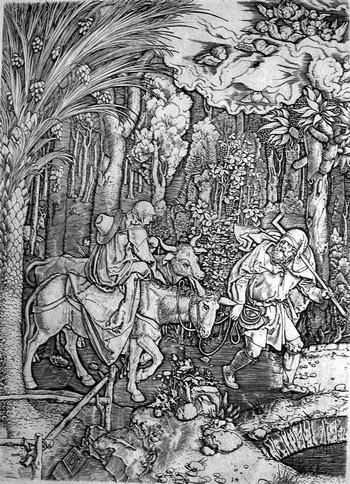
The strong fascination for German engraving, together with commercial reasons, led him to translate the well-known series of woodcuts of the Life of the Virgin by Albrecth Dürer onto copper plates, with the engraving technique, thus incurring the accusation of falsification by the German artist. Around 1510 he moved to Rome where he remained until the sack of the town in 1527.
In Rome he met Raffaello, in the Baviera’s workshop, establishing with him a solid relationship of collaboration, translating in prints many of his drawings. In fact, he quickly established himself as an interpreter of the Urbino master. However, alongside with engravings of the subjects designed by Raphael and his pupils such as Giovan Francesco Penni and Giulio Romano, he has continued to produce prints of his own invention and his influence remained decisive on all the 16th century graphics.
Due to licentious engravings taken from drawings by Giulio Romano, he ended up in prison for some time.
In 1515-1516 in Marcantonio’s works we observe a greater interest in the chiaroscuro effects of the compositions. It is possible that this change of style had been influenced by the arrival of Agostino Veneziano and Marco Dente with whom he undertook a strong collaboration at the workshop of Baviera.
His activity ended with the sack of Rome during which he was forced to leave all his belongings to the invaders to save his life. After returning to Bologna, he died in poverty in 1534.