
SCHÖN Erhard
(Nuremberg 1491 – 1542)
German draftsman, painter and wood engraver, son of Marx Schön III, a modest painter from Nuremberg who probably was also his first master in the art of drawing. He lived his artistic career under the strong influence of Dürer’s work. Most of his early years and his first training is unknown, and very little is known about his life. It is believed that in 1538 he owned a workshop. He was a very prolific artist: about 1200 drawings for woodcuts are attributed to him, partly carved by him and partly by others.
He collaborated with Springinklee in designing the woodcuts of Hortulus Animae and Biblia, both printed by the publisher Anton Koberger in 1516 and 1518 respectively.
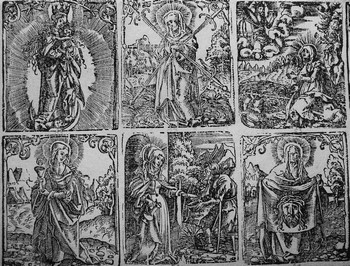
Erhard contributed with some woodcuts to Theuerdank, a great work commissioned by Emperor Maximilian who involved several active artists in Nuremberg. His woodcuts are simple and often small sized, designed to be printed in a large number of copies for popular books, rather than for a refined people of connoisseurs.
Apart from these devotional works, his woodcuts illustrate mythological and historical subjects as well as allegorical, satirical and anticlerical scenes appreciated by the Protestant reformers.
Erhard Schön is also remembered as an ‘anamorphosis’ draftsman. Anamorphic representations create an optical illusion, whereby an image is projected onto a plane in a distorted manner and is recognizable only when viewed from a precise position. Since the Renaissance, various painters (including Leonardo and Hans Holbein the young) have used anamorphism to hide more profound meanings in the works.