

WEIROTTER Franz Edmund
(Innsbruck 1730 – Vienna 1771)
Austrian engraver, draftsman and painter, son of the carpenter Anthon Weirauther and Gertraud Orner.
Orphan at the age of seven, he was assigned to an aunt with whom he remained until the age of fourteen.
At a very young age he went first to Vienna, then to Regensburg and then again to Mainz where he worked for some time at the service of Elector Conte d’Olstein. Finally he moved to Paris and met the etcher and draftsman Johann Georg Wille, of which he became a pupil. Since the young Weirotter was devoid of resources, his teacher Wille commissioned him works, several times on different occasions to provide for his livelihood.
Surely he did then those Views of the Seine, six small etched tables, that Wille paid him four gold coins. The teacher continued to take an interest in his pupil and friend, buying drawings and paintings.
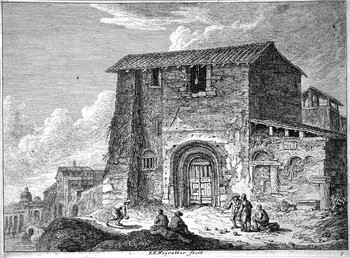
The special charm of Weirotter’s works consists in the faithful transposition of the landscape and nature observed, without those additions or modifications required according to the taste of time.
His representations of landscapes filled with light and air are without mythological and religious themes. This demonstrates his antipathy to fashion in France in which the subjects were characterized by pastoral scenes or compositions with gallant images.
In Weirotter’s graphic work there are mainly the following subjects: wide hilly landscapes, views of ports, internal courtyards, decadent houses and ruins of antiquity invaded by vegetation. In 1767 he was appointed professor of drawing at the Vienna Academy. Over time, the importance of Weirotter has become increasingly evident. In fact, as an author of etchings is listed among the most interesting artists of the time between the fading baroque and romance still at its beginning.
He made over two hundred etchings, many derived from his own or Wille’s drawings, others reproducing other people’s subjects.