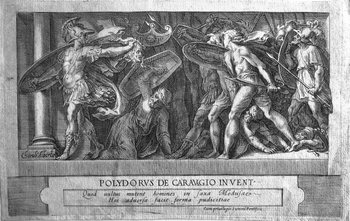


ALBERTI Cherubino
(Borgo San Sepolcro 1553 – Rome 1615)
Italian painter and engraver, also known as ‘the Borgheggiano’ in reference to his place of origin: Borgo San Sepolcro. After studying drawing and painting with his father Michele, a painter and carver of wood, he dedicated his first creative phase to intaglio. In this art we do not know who his mentor was, but his style is similar to Agostino Carracci’s.
At the end of the century, the artist began to dedicate himself to painting preferring the fresco technique almost exclusively. He went to Rome where he attended the school of Cornelis Cort learning the burin technique, which he could express at high levels of quality.
His activity as an engraver reached the stage of greatest intensity during the 1580-1590 decade with the execution of works derived from Raphael, Andrea del Sarto, Polidoro da Caravaggio, Rosso Fiorentino and Federico Zuccari.
In 1593 he collaborated in Rome to the restoration of the Academy of St. Luke and the following year he was involved in the decorative part of the Farnese Gallery. In 1595, at the request of Pope Clement VIII, he was assigned the task of the decoration of the walls and the vault of the Sala Clementina.
During this work he has been convicted of murder, but thanks to the papal safe conduct, was released in order to complete the work begun and eventually remained unpunished. In more recent years, it seems that the artist neglected both intaglio printing or painting to concentrate on the design of war instruments.
Cherubino Alberti died in October 1615 in Rome and buried in the family tomb in the Church of Santa Maria del Popolo.